

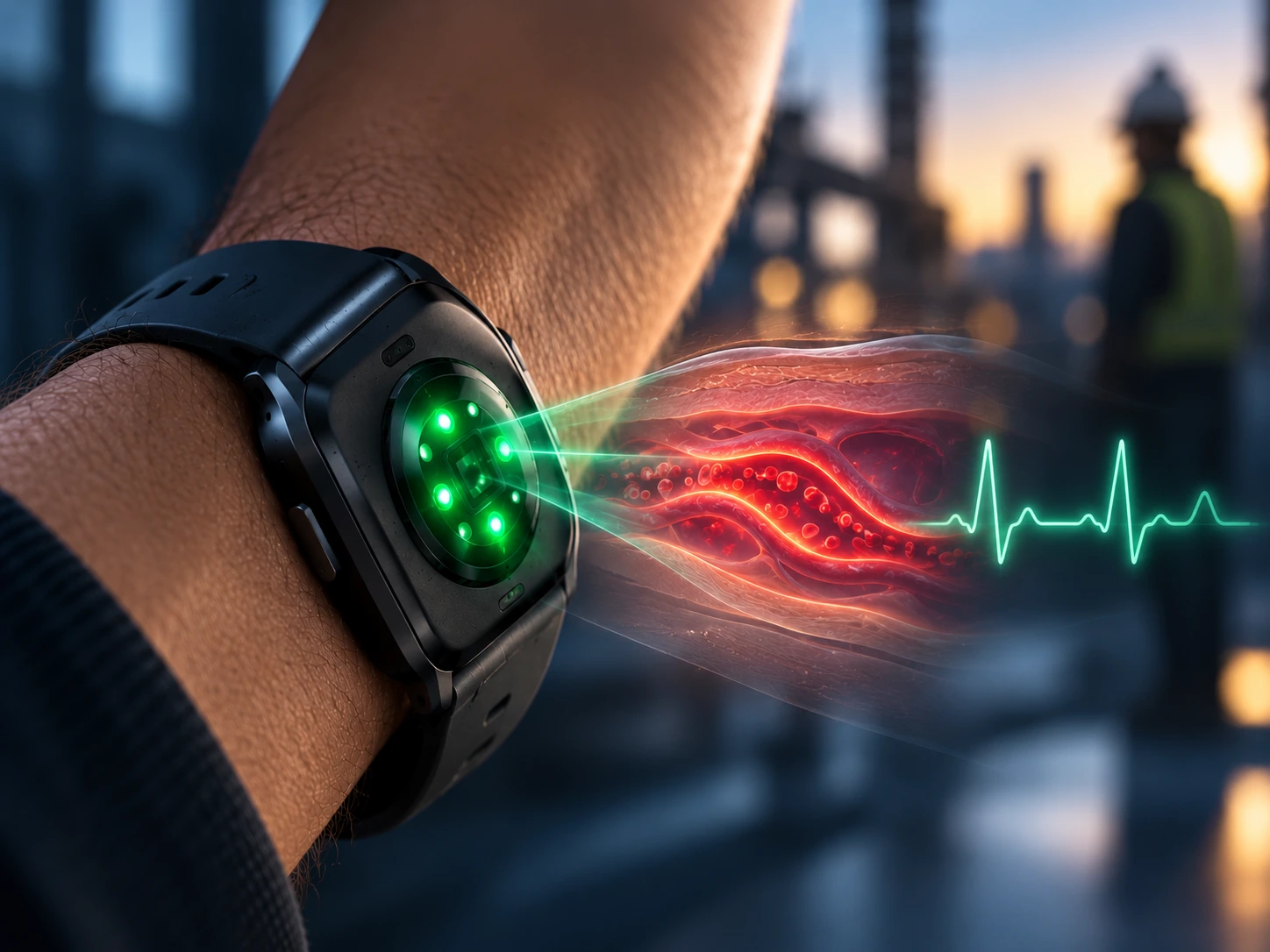
If you turn a smartwatch over, you will usually see something interesting on its underside: a small collection of flashing green lights.
Those lights are not there for decoration. They are measuring changes in the blood flowing beneath your skin. This is how most modern smartwatches estimate your heart rate.
The Green Lights Under Your Watch
The technology used by many smartwatches is called photoplethysmography, usually shortened to PPG.
The basic idea is surprisingly simple. When your heart beats, it pumps blood through the blood vessels in your body. This causes the volume of blood near the surface of the skin to change slightly with each heartbeat. Blood absorbs light differently from the surrounding tissue.
A smartwatch takes advantage of this by shining light into the skin and measuring how much of that light is reflected back. When more blood is present beneath the sensor, the amount of reflected light changes. When the amount of blood decreases, the reflected light changes again. These small changes create a repeating pattern that corresponds roughly to the pulse created by your heartbeat.
Why Green Light?
You may wonder why most smartwatches use green LEDs.
Green light is commonly used because it can produce a strong optical signal when measuring changes in blood volume near the surface of the skin. However, green is not the only wavelength used in wearable sensing. Some devices may use red or infrared light for other types of measurements or under different sensing conditions.
The light itself is only one part of the system. The smartwatch also contains a photodetector—a component that measures the light reflected back from the skin. Together, the LEDs and photodetector form an optical sensing system.
Turning Light Into a Heart Rate
The raw signal collected by the sensor does not simply say:
“Your heart rate is 72 beats per minute.”
Instead, it contains tiny fluctuations in reflected light. The watch must first identify the repeating pattern associated with the heartbeat. It then estimates the time between consecutive beats. For example, if there is approximately one second between heartbeats, the heart rate would be around 60 beats per minute.
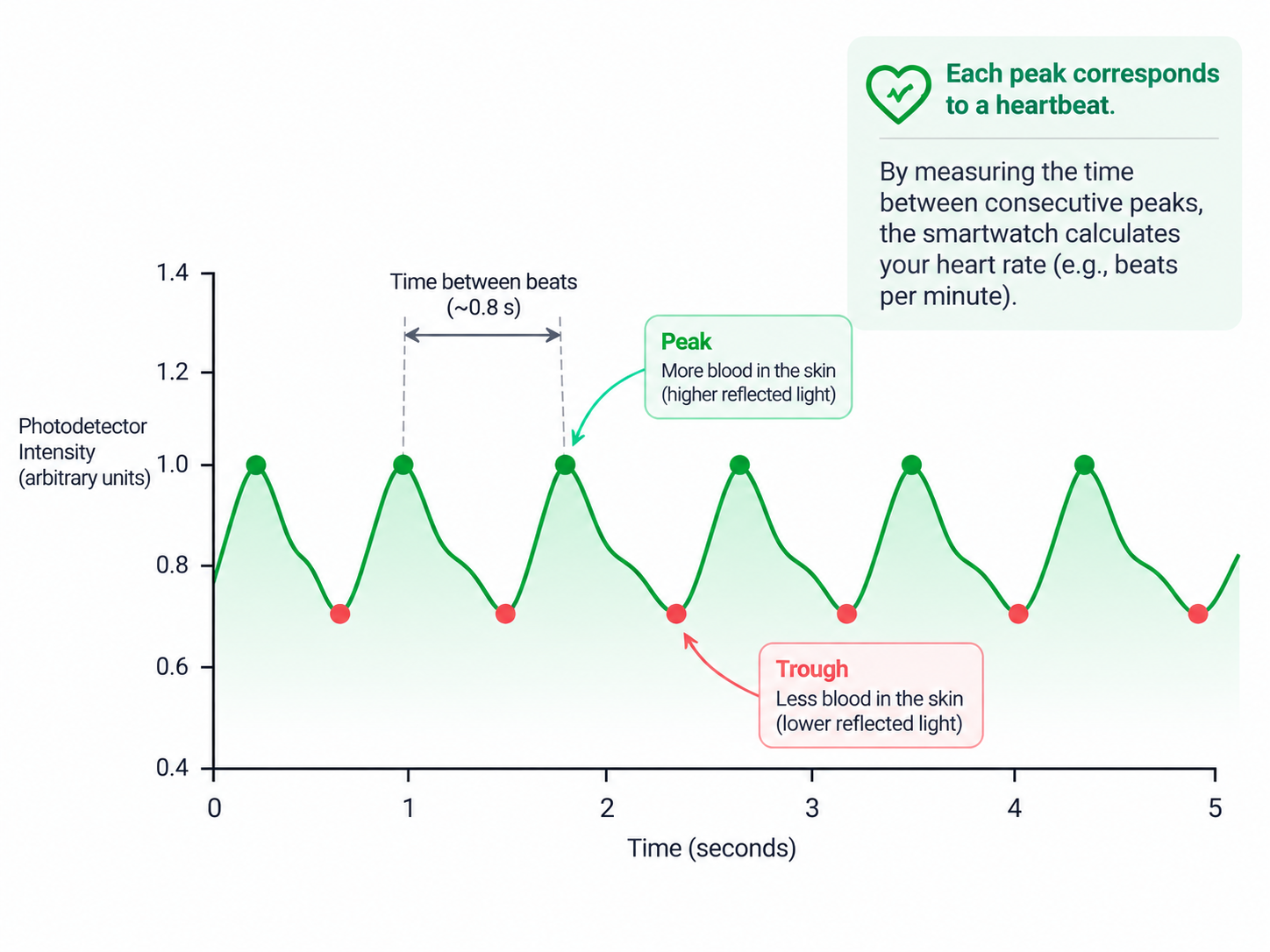
In simple terms:
Light → Reflected signal → Pulse pattern → Time between beats → Heart rate
The calculation is relatively straightforward once a clean pulse signal has been identified. Getting that clean signal, however, can be much more difficult.
The Real Challenge: Noise
Your wrist moves. The watch shifts slightly. Your arm swings while walking. Your skin may not maintain perfect contact with the sensor. All of these factors can affect the optical signal.
This is one of the biggest challenges in wearable sensing: separating the real physiological signal from everything else.
A smartwatch therefore does not rely only on the optical sensor. It can also use algorithms and other sensors, such as accelerometers, to better understand whether movement may be affecting the measurement. This is why heart-rate accuracy can vary depending on how the watch is worn and what the person is doing.
A properly fitted watch usually provides a better optical signal than one that moves freely on the wrist.
Just to summarise what we covered till now :
A heart-rate reading may look simple on a screen, but the technology behind it involves multiple layers.
There is the optical hardware that produces and measures light. There is signal processing that extracts a pulse pattern. There are algorithms that attempt to remove noise. And finally, there is the interpretation that turns those measurements into a number a person can understand.
This illustrates an important principle in wearable technology:
Collecting data is only the first step. Understanding it is the real challenge.
From Fitness Tracking to Human Safety
The same principle becomes increasingly important as wearables move beyond fitness tracking.
In a consumer smartwatch, a heart-rate measurement might help someone understand their workout. In a safety-focused wearable, physiological data could potentially become one part of a much larger picture.
Heart rate by itself does not necessarily indicate danger.
But when it is considered alongside movement, location, activity and environmental conditions, it may provide additional context about what is happening to a person.
A sudden change in physiological response might be perfectly normal during physical work. The same change, combined with unusual movement and prolonged exposure to hazardous conditions, could potentially tell a different story.
This is why companies like Elymentals are interested not only in what wearable sensors can measure, but also in how those measurements can be understood in context.
The future of intelligent wearables may not simply involve collecting more data from the human body.
It may involve learning how to connect that data with the world around the person—and understand when the combination of signals actually means something important.